10,000+ Lean Six Sigma professionals use Essam.ai. That is not a coincidence. It is the result of a specific, recurring problem that every Black Belt and Green Belt eventually confronts: the gap between finishing the Analyze phase and producing documentation that operations teams can actually use.
This post explains why that gap exists, why it costs organizations more than most project sponsors realize, and why Essam.ai closes it without compromising the methodology.
The Problem Every Black Belt Knows
DMAIC is sound. Define, Measure, Analyze, Improve, Control — the five-phase framework produces defensible results when executed rigorously.
The friction is not in the methodology. It is in the documentation cycle that follows the Analyze phase.
A typical DMAIC improvement project reaches the Improve phase with a clear diagnosis: the waste is identified, the root cause is confirmed, and the redesign recommendation is ready. Then the timeline stalls.
- Process mapping takes days or weeks to document properly
- SOP drafts go through multiple review cycles before approval
- Stakeholder presentations require separate work to prepare
- Control plans need to be built after the SOP is finalized
- Deployment to frontline teams introduces its own lag
The result: a project that completed root cause analysis in week 6 may not have a deployed SOP until week 14. The improvement exists on paper. The process continues running the old way.
For organizations losing 30% of annual revenue to bad processes, that 8-week gap is not a documentation problem. It is a revenue problem.
What Lean Six Sigma Black Belts Actually Need
Black Belts are not looking for simpler software. They are looking for a tool that respects DMAIC rigor while accelerating the steps that do not require human judgment.
Specifically, the steps between:
- "I know what the current-state process is" (Analyze output)
- "My team is running the improved process" (Control input)
This gap spans process redesign, SOP generation, stakeholder communication, and deployment. These are high-effort, low-complexity tasks for a practitioner with DMAIC fluency. They are exactly what agentic AI handles well.
How Essam.ai Is Built for DMAIC Practitioners
Baseline-to-Analysis Through Conversation
Essam.ai conducts process baselining through a chat-based interface. A Black Belt describes the current-state process conversationally. The platform generates the process map, identifies waste categories, and flags root cause candidates — aligned to Lean Six Sigma waste taxonomy: overproduction, waiting, transport, over-processing, inventory, motion, defects.
This is the Measure and Analyze phase accelerated, not replaced. The practitioner's judgment about which waste matters most remains the deciding factor.
E-S-S-A-M as the Improve Phase Engine
Once the analysis is complete, Essam.ai applies the E-S-S-A-M framework — Eliminate, Simplify & Standardize, Automate, Migrate — to each activity in the process map.
This is how DMAIC's Improve phase recommendation becomes an executable redesign, not a consultant slide deck.
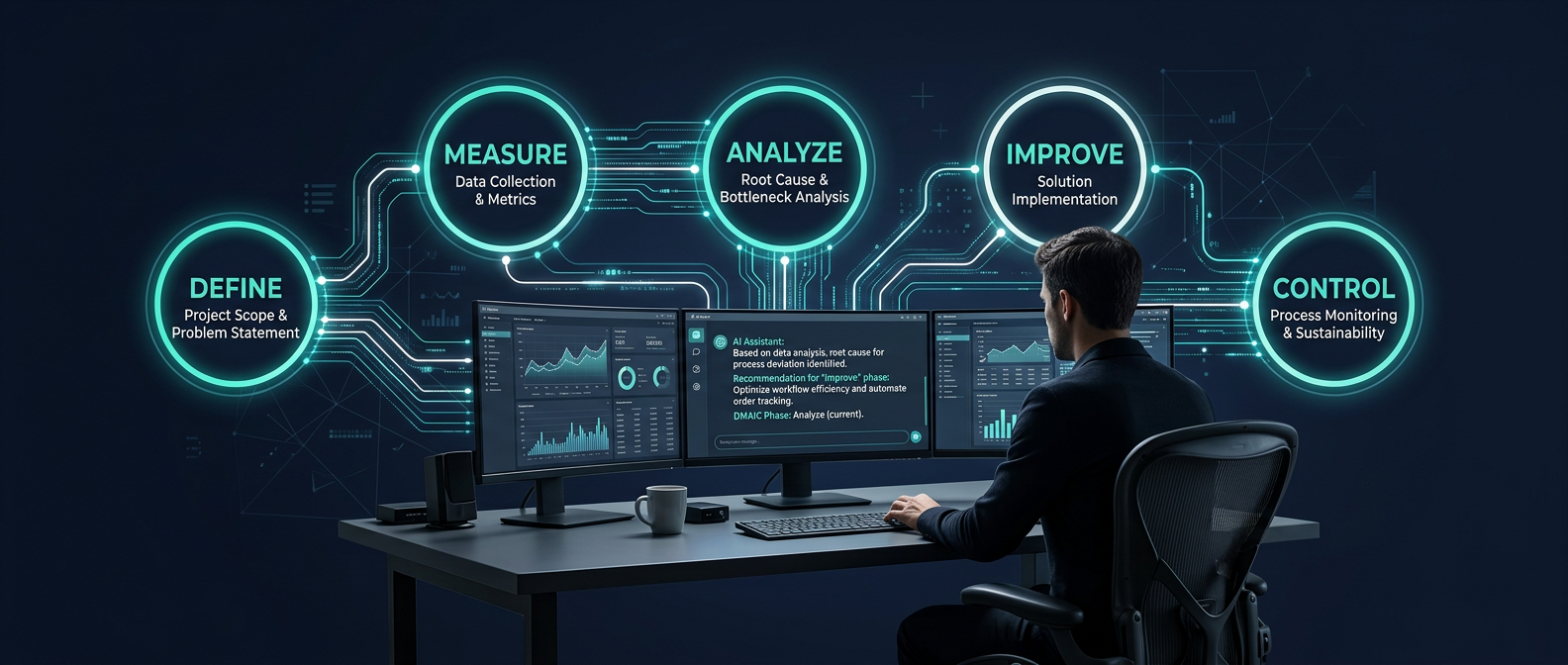
| DMAIC Phase | What Essam.ai Handles |
|---|---|
| Measure | Baseline mapping through conversation |
| Analyze | Waste identification and categorization |
| Improve | E-S-S-A-M treatment applied per activity |
| Control | SOP generated, RACI documented, deployment via WhatsApp |
Outputs That Ship on Day One
Every session produces a ready-to-deploy package:
- Audit-ready Standard Operating Procedure (SOP): Formatted, signed off, deployable
- Stakeholder presentation: Executive-ready slides for the project sponsor or COO
- Before/after process comparison: Quantified against the baseline
- RACI matrix: Roles and responsibilities at the activity level
- OLA (Operational Level Agreement): Service-level commitments documented
- WhatsApp deployment: SOP pushed directly to frontline teams
A Black Belt presenting at the next project review does not need to build these separately. They exist as outputs from the Essam.ai session.
Why This Matters for Practitioners, Not Just Organizations
Black Belts operate under project timelines. Sponsors expect results on schedule. The documentation cycle is often the reason projects run late — not the analysis, not the improvement design.
When documentation compresses from weeks to a single session, two things happen:
1. More projects complete on time. The Control phase begins earlier. Improvements go live faster. Results show up in the next QBR.
2. Black Belts take on more projects. The limiting factor shifts from documentation capacity to analytical capacity. That is where a practitioner's training is best applied.
Essam.ai does not replace Black Belt expertise. It removes the bottleneck that limits how much of that expertise an organization can deploy.
A Tool That Speaks Lean Six Sigma
The platform is built with LSS vocabulary as a first-class design constraint. Process waste categories, DMAIC phases, SOP structure, and control plan format are native to the interface — not retrofitted.
This means a Black Belt working in Essam.ai does not need to translate methodology concepts into generic business software language. The platform meets practitioners where they already are.
Ready to Run Your Next DMAIC Project Faster?
Lean Six Sigma practitioners who use Essam.ai complete baseline-to-SOP in minutes, not weeks. If your current documentation cycle is the reason your improvement projects run late, that gap has a structural solution.