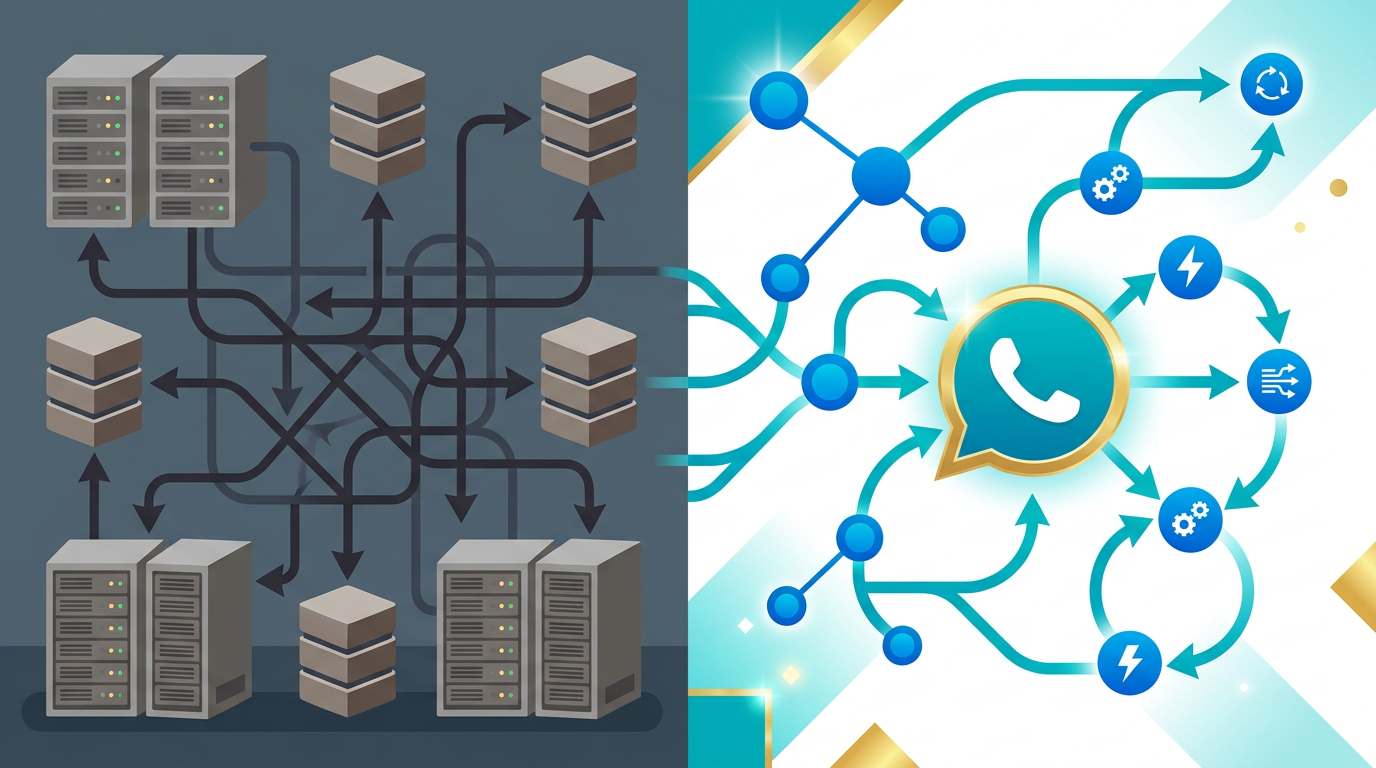
139 days to process a single procurement cycle. That was the baseline at a MENA-region bank before ESSAM cut it to 33.5 days — a 75.9% reduction, delivered in weeks. McKinsey's May 2026 report "The End of ERP as We Know It" describes this exact architecture as the future of enterprise operations. It's already running in production.
McKinsey's eight-page thesis argues that AI agents will dismantle the front end of every ERP system, replacing manual screens, transactions, and handoffs with autonomous agents that mediate, decide, and execute. They call it "headless ERP": the system of record stays (SAP, Oracle), but an agentic layer above it orchestrates processes end to end.
That agentic layer is what ESSAM has been deploying inside banks for the past 12 months.
What McKinsey's "agentic operating model" actually means
McKinsey defines the agentic operating model as a new execution layer that sits on top of existing enterprise systems. It doesn't replace SAP or Oracle. It replaces the human mediation layer — the screens, the manual handoffs, the transactions that require someone to log in, navigate, and click submit.
The report identifies three shifts. Individual bots handling discrete tasks are being replaced by agents that manage entire workflows across systems. The organizing principle moves from "which system handles this data" to "what does this process need to achieve." And the agentic layer doesn't get implemented and handed off — it runs continuously, adapting as processes change.
McKinsey reports early adopters seeing EBIT improvements of 5% or more and estimates ERP implementation effort could be reduced by at least 50%. Those are research-backed projections. ESSAM has live case data.
How ESSAM already operates as an agentic process layer
ESSAM is an AI Process Engineer. It sits above existing systems — core banking platforms, ERP, document management tools — and engineers the processes that run across all of them.
The 7-step AI Lean Cycle is the agentic operating model in working form:
- Baseline — Captures the current process through conversation. No system integration required. A 23-step procurement workflow was baselined in a single 40-minute chat.
- Map — Identifies all steps, handoffs, wait times, and decision points. The practitioner validates. Eight non-value-adding steps were flagged in the procurement case.
- Analyze waste — Applies the E-S-S-A-M waste classification framework (Eliminate, Simplify, Standardize, Automate, Migrate) to every step.
- Optimize — One command triggers complete workflow redesign. Procurement dropped from 23 steps to 12. Cycle time: 139 days to 33.5.
- Document — SOP, boardroom presentation, RACI matrix, and policy auto-generated from the optimized state.
- Deploy — Updated process sent to every staff member via WhatsApp. 39% of banks already use WhatsApp for operations. Adoption follows because the channel is already there.
- Improve — Front-line staff share feedback through the same WhatsApp channel. One command incorporates validated improvements. The cycle repeats.
What McKinsey calls "the agentic operating model," ESSAM calls the 7-step AI Lean Cycle. The difference is that McKinsey published a thesis and ESSAM deployed a working system.
The "pilot purgatory" problem McKinsey identifies — and how ESSAM avoids it
McKinsey names a specific trap: "pilot purgatory." AI use cases that are too small and too disconnected to create measurable P&L impact. Organizations launch 50 pilots, none of them scale, and the board asks where the ROI went.
The ESSAM architecture avoids this by design. Every engagement ends with three things that make purgatory structurally impossible. Staff are already using the new procedure via WhatsApp by end of the engagement — not a recommendation, not a slide deck, a deployed process. Cycle time, step count, and efficiency are calculated automatically, so the before-and-after is always visible and auditable. And staff feedback triggers the next optimization cycle, so the process doesn't decay after the consultant leaves — because there was never a consultant in the first place.
McKinsey reports that only 25 to 35% of large tech programs achieve their targeted EBITDA and cash-flow impact, while 65 to 80% exceed their planned budget or timeline. ESSAM customers bypass that statistic entirely because the platform runs without IT builds, consulting engagements, or multi-year migration programs.
The competitive threat McKinsey warns about
McKinsey's report carries an explicit warning: SAP, Oracle, and Microsoft are racing to embed agentic AI natively into their platforms. If they succeed, the agentic process layer becomes a feature of SAP Copilot, not a standalone category.
This is worth taking seriously, and I'd be skeptical of any vendor that waves it away. Three structural reasons it doesn't eliminate the standalone process layer — at least not in the near term:
ERP platforms are optimized for data consistency and system transactions. They're not optimized for the experience of a COO trying to fix something broken in their operations. Redesigning that architecture takes years. Meanwhile, ERP vendors sell to IT departments. The agentic process layer serves Heads of Operations and Process Improvement teams who need results this quarter, not after the next ERP migration. And ERP upgrades require change management programs, training sessions, and new portals. ESSAM deploys via WhatsApp. Staff already use it.
The ERP giants will eventually embed agentic capabilities. The honest question is whether a bank can afford to wait 3-5 years for that migration when the operational inefficiency is reportedly costing 30% of revenue annually right now.
What this means for banking specifically
Banking is where every trend McKinsey identifies converges at once.
A typical bank runs hundreds of interconnected processes across compliance, operations, lending, and customer service. Every process change requires an audit trail — and ESSAM auto-generates the baseline, waste analysis, optimization rationale, approval record, and deployment log in one auditable system. Around 70% of IT budgets go to maintaining existing infrastructure, according to ESSAM.ai. The budget for actual transformation is what survives that. And staff operating broken processes every day cannot wait for a 4-year ERP migration to start working differently.
The banks that gain a durable edge won't necessarily be the ones with the biggest IT budgets. They'll be the ones that deploy the agentic process layer now, while competitors are still running ERP RFPs.
Key numbers
- 139 → 33.5 days — procurement cycle time before and after ESSAM at a MENA-region bank (75.9% reduction)
- 80% — reduction in documentation time from chat-based process capture (ESSAM.ai, 2026)
- 10,000+ — Lean Six Sigma professionals currently using ESSAM.ai
- 70% — of IT budgets consumed by legacy system maintenance (ESSAM.ai)
- 30% — revenue organizations lose annually to broken or inefficient processes (ESSAM.ai)
- 25-35% — of large tech programs that achieve their targeted financial impact (McKinsey, 2026)
- 5%+ — EBIT improvement reported by early adopters of agentic AI operations (McKinsey, 2026)
- 2-5 people — size of the bank's Six Sigma team that achieved enterprise-wide transformation with ESSAM
FAQ
What is the agentic operating model McKinsey describes?
An execution layer that sits on top of existing enterprise systems (SAP, Oracle) and orchestrates processes end to end using AI agents. Instead of humans navigating ERP screens, agents mediate, decide, and execute workflows autonomously. McKinsey calls this "headless ERP."
How does ESSAM relate to McKinsey's thesis?
ESSAM has been operating as an agentic process layer inside banks for 12 months. The 7-step AI Lean Cycle — baseline, map, analyze waste, optimize, document, deploy, improve — executes the architecture McKinsey describes as the future of enterprise operations.
Does ESSAM replace ERP systems?
No. ESSAM sits above existing systems. Core banking platforms, SAP, Oracle — they stay as the system of record. ESSAM engineers and deploys the processes that run across these systems without requiring integration or IT builds.
What is "pilot purgatory" and how does ESSAM avoid it?
McKinsey's term for AI projects that stay small, disconnected, and unmeasurable. ESSAM avoids it by ending every engagement with a deployed process (not a recommendation), a measurable before-and-after metric, and a continuous improvement loop via WhatsApp feedback.
Can ERP vendors build this themselves?
Eventually. SAP, Oracle, and Microsoft are all investing here. The constraint is architectural — ERP platforms are optimized for data consistency, not process outcomes. Redesigning that takes years. ESSAM delivers the agentic process layer now, for banks that can't wait for the next migration cycle.
The 25-35% success rate on large tech programs isn't a technology problem. It's a delivery problem. The methodology was always sound. The gap was between insight and deployment: formatting, approvals, version control, training, adoption.
ESSAM closes that gap in a single session. The same 2-5 person Six Sigma team that previously completed one process improvement per quarter now starts new ones weekly. The core banking system is never touched. The team never expands. The enterprise transforms anyway.
See how the agentic process layer works on your operations →