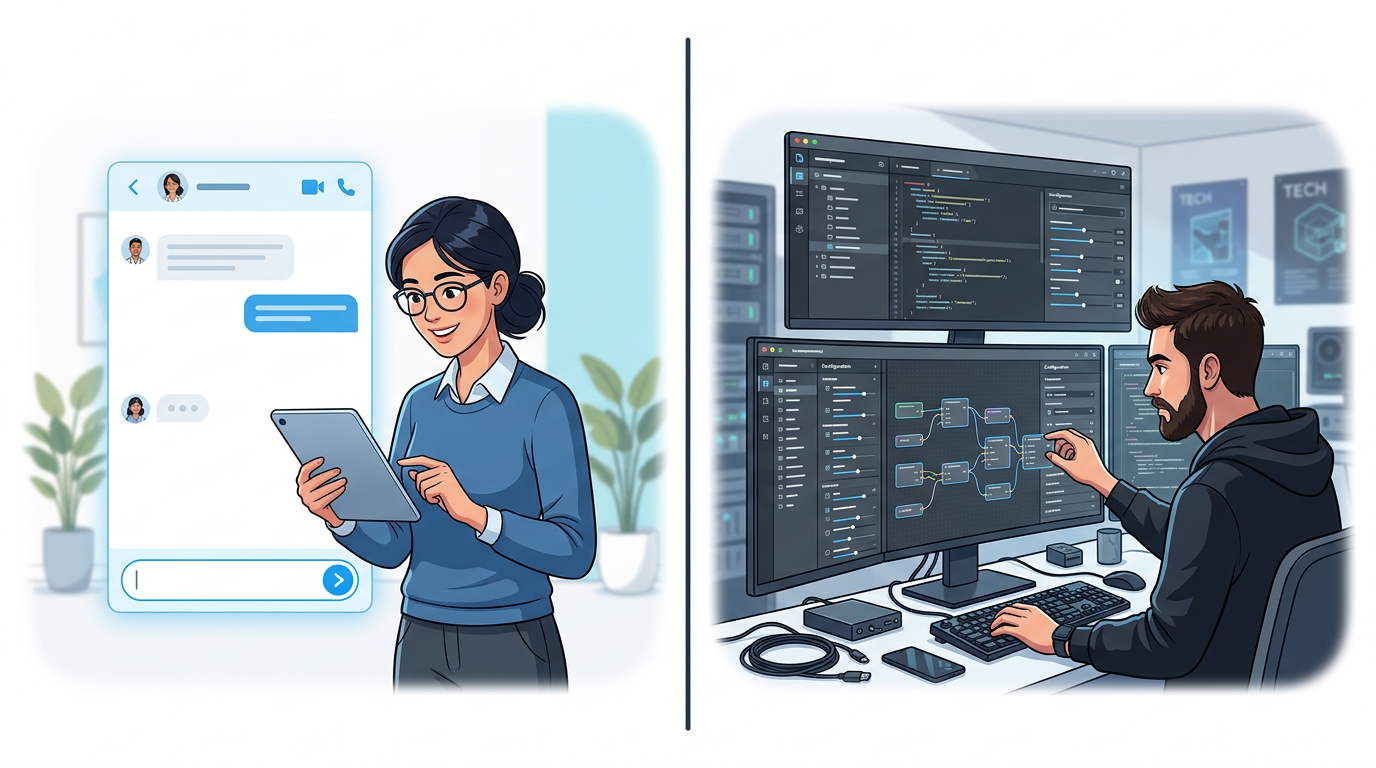
If you are evaluating ESSAM alongside a BPM workflow platform as competing tools, you are solving the wrong problem. These categories do not compete. They serve different buyers, different moments, and different definitions of "done." This post explains what each does, where each fits in a banking process improvement cycle, and why practitioners who use both use them in sequence — not instead of each other.
At a Glance: Process Improvement vs. Workflow Automation
| Dimension | ESSAM | BPM Workflow Platforms |
|---|---|---|
| Primary buyer | Process improvement practitioner (LSSBB) | IT team / developer |
| Implementation | Browser-based, same day | IT project, months |
| Methodology | Lean Six Sigma (E-S-S-A-M framework) | Workflow engine (no built-in methodology) |
| SOP / documentation | Auto-generated with board presentation | Not included |
| WhatsApp deployment | Built-in (Step 5 of 7 in the framework) | Not available |
| APAC / banking focus | GCC + APAC, Gulf regional bank case study | Primarily US/EU enterprise market |
| Pricing | $40/month Basic to Enterprise (ESSAM.ai/pricing) | Enterprise pricing only |
| IT support required | None — zero IT tickets to run a cycle | Significant — developer allocation required |
What BPM Workflow Platforms Are
BPM workflow platforms are automation infrastructure. IT teams buy them. Developers configure them. They cover case management, intelligent document processing, decision management, and other BPM sub-categories. They are built for enterprises that need to codify and automate complex workflows at scale, with audit trails and system integrations built in.
These platforms are powerful inside their domain. That domain is workflow infrastructure. They assume the process is already defined, validated, and approved. They run the process. They do not improve it.
The limitation is not the platform — it is the buyer assumption baked into the product. BPM platforms are built for IT teams who manage enterprise workflow infrastructure. Non-technical staff hit a wall fast. Industry reviewers are direct: these tools are powerful but overly complex and difficult to use for non-technical staff. Users frequently report a steep learning curve and the need for significant IT support.
For an LSSBB practitioner in a regional bank, that wall appears on day one.
What ESSAM Is
ESSAM is an AI process improvement platform built for practitioners — Black Belts, Lean Six Sigma professionals, and process improvement leads who need to map, analyze, optimize, and deploy a process without raising an IT ticket.
The platform follows a seven-step methodology structured around the E-S-S-A-M framework. A practitioner opens a chat session, describes the process, and works through each phase: from current-state mapping to root cause analysis, waste elimination, SOP generation, and deployment. Step 5 of 7 deploys the new SOP to staff via WhatsApp — no app install, no IT configuration.
More than 10,000 LSSBB professionals use ESSAM globally (ESSAM.ai). A Gulf regional bank documented a 59% cycle time reduction on a trade finance approval process after running an ESSAM improvement cycle (ESSAM.ai case studies). ESSAM's Basic plan starts at $40/month. Running a full improvement cycle requires zero IT tickets.
ESSAM does not run workflows at scale. That is not its job. Its job is to produce a validated, documented, director-approved process — one worth automating.
Five Dimensions Compared in Depth
1. Implementation Speed
A BPM platform implementation is an IT project. Developer allocation, system integration, testing cycles, change control — the timeline runs in months. For a practitioner who needs to improve a process this quarter, that timeline is not workable.
ESSAM runs in a browser. A practitioner can complete a current-state process map in a single chat session on day one. No installation. No onboarding project. No IT involvement.
2. Methodology
BPM platforms provide a workflow engine. The methodology — Lean Six Sigma, DMAIC, FMEA, waste elimination — is not built in. Practitioners bring their own frameworks and apply them outside the tool.
ESSAM embeds the methodology. The seven-step E-S-S-A-M framework guides practitioners through define, measure, analyze, improve, and control phases. FMEA is built into the analysis step. Waste identification follows Lean principles. The tool does not assume the practitioner knows what to do next — it shows them.
3. SOP and Documentation
BPM platforms do not generate SOPs. They run the process once the SOP is created, approved, and configured by a developer.
ESSAM auto-generates the SOP at the end of the improvement cycle. It also produces a board-ready presentation — before/after comparison, root cause summary, projected impact. That documentation is the handoff artifact. It is what practitioners submit to IT as the specification for the workflow automation build.
4. Banking and APAC Focus
Most BPM platforms target US and European enterprise markets. Their documentation, case studies, and sales motion address North American and European IT buyers.
ESSAM is built for GCC and APAC banking contexts. The primary published evidence is a Gulf regional bank case study: a 59% cycle time reduction on a trade finance approval workflow. See the full case study. The platform accounts for the approval hierarchies, WhatsApp adoption rates, and regulatory documentation requirements common in Gulf and Southeast Asian banks.
5. Pricing and Access
BPM platforms typically do not publish pricing. Enterprise-only contracts mean a procurement process before a practitioner can evaluate the tool.
ESSAM's Basic plan is $40/month. A practitioner can run a complete improvement cycle, generate an SOP, and present findings to a director before a budget conversation happens.
The Sequence, Not the Choice
Most evaluation frameworks break down here. The question is not ESSAM versus a BPM platform. The question is: which comes first?
ESSAM comes first.
ESSAM improves the process. The BPM platform systemizes it. These are sequential activities, not competing ones. A process that has not been improved is not worth automating at scale. Automating a broken process faster is not progress — it is expensive failure, delivered quickly.
Improve first. Then automate.
A Real Scenario: Trade Finance at a Regional Bank
A Head of Process Improvement at a regional bank identifies a problem: the trade finance approval workflow has eight non-value-adding steps and two redundant approval stages. She takes the finding to IT. IT confirms the workflow runs in the bank's BPM platform. A change request is required. Developer allocation, testing cycle, approval chain. Four months, minimum.
She opens ESSAM in parallel.
Week one: she maps the full 20-step process in a chat session. The tool flags the redundant approval stages and quantifies the waste.
Week two: an optimized 12-step process is reviewed and approved by her director. ESSAM generates the SOP and the board presentation automatically.
Week three: the new SOP is deployed to trade finance staff via WhatsApp. No app download. No IT ticket. Staff are operating the improved process.
Week five: she submits the optimized process to IT as the new workflow specification — with full documentation, before/after comparison, and director sign-off already attached.
IT implements it in month four. By then, the improvement has been live for three months. The cycle time reduction is already showing in the data. The BPM build is not the improvement — it is the infrastructure that locks the improvement in permanently.
This is the correct sequence.
Decision Matrix
Choose a BPM workflow platform if:
- IT owns and manages workflow infrastructure
- The process is already validated and approved
- You need complex enterprise-scale automation with deep system integrations
- Developer resources are allocated and available
Choose ESSAM if:
- A practitioner (LSSBB, Black Belt, process improvement lead) owns the mandate
- The process needs analysis, optimization, or documentation before it can be automated
- Rapid deployment to staff is required — days, not months
- Your bank operates in GCC or APAC and needs WhatsApp-native SOP delivery
Use both if:
- Your bank has standardized on a BPM platform for workflow automation
- AND has a process improvement function that needs to work faster than IT change cycles
- ESSAM is the improvement layer. The BPM platform is the automation layer.
- The outputs of an ESSAM cycle become the inputs for the automation build.
What to Do If Your Bank Has Already Standardized on a BPM Platform
ESSAM is not a replacement. It is the upstream layer that makes automation builds better.
Every workflow spec your IT team receives from an ESSAM cycle comes with: a validated optimized process, a full SOP, a director-approved before/after comparison, and projected impact data. IT gets a better spec. The workflow automation is built on a validated process, not a first draft. Change requests decrease. Rework decreases.
ESSAM produces better inputs for your automation platform. That is the integration story.
Frequently Asked Questions
What is the difference between ESSAM and a BPM workflow platform?
ESSAM is an AI process improvement platform for practitioners. It follows the Lean Six Sigma E-S-S-A-M framework and produces validated, documented, optimized processes. BPM platforms are workflow automation tools for IT teams. They run codified processes at scale. ESSAM improves the process; BPM platforms automate it.
Which is better for banks and financial services?
It depends on the buyer. IT teams managing workflow infrastructure at scale will find BPM platforms suited to their mandate. Process improvement practitioners — LSSBB professionals, Black Belts, continuous improvement leads — will find ESSAM built for their workflow. Banks with active process improvement functions in GCC or APAC markets have specific evidence to consider: a Gulf regional bank documented a 59% cycle time reduction on a trade finance workflow after running an ESSAM improvement cycle.
Can ESSAM and a BPM platform be used together?
Yes. The optimal sequence is ESSAM first, BPM platform second. ESSAM's improvement cycle produces a validated process with full documentation and director sign-off. That documentation becomes the specification for the workflow automation build. The improvement is live faster (via ESSAM's WhatsApp deployment), and the IT build starts from a better brief.
Do BPM platforms have a Lean Six Sigma methodology?
No. BPM platforms are workflow engines. Lean Six Sigma methodology — DMAIC phases, FMEA, waste identification, cycle time analysis — is not built into these platforms. Practitioners who use BPM tools bring their own methodology and apply it outside the tool. ESSAM embeds the E-S-S-A-M framework directly into the platform workflow, guiding practitioners through each improvement phase.
Final Word
BPM platforms manage the workflow after it is built. ESSAM builds the process worth managing. They serve different moments in the same improvement cycle.
If your bank's process improvement function is waiting on IT change cycles to validate and deploy improvements, the bottleneck is not IT. It is the absence of a practitioner-owned improvement layer. That is what ESSAM is built to close.
Book a Process Improvement Review
See ESSAM in your bank's context.
Walk through a live improvement cycle for a process your team is currently working on — from current-state map to optimized SOP in a single session. Bring a real process. Leave with a real output.